

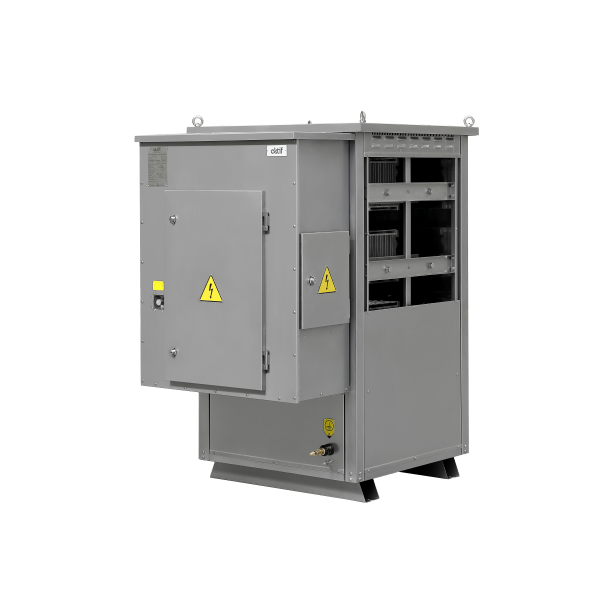

Over 90% of short circuits in power transmission lines are phase-to-ground faults. Neutral Grounding Resistance, achieved by grounding the neutral point through a resistor, is an effective solution to protect transformers in such cases.
Description
The purpose of Neutral Grounding;
• Limit the ground fault current to prevent any damage to the transformer and the generator and ensure operation continuity and safety
• Provide sensing the fault current with the relays by means of current transformer mounted inside the Neutral Grounding Resistor and limiting the fault duration
• Limit oscillating and non-oscillating transient voltage caused by the interruption of the failure current and so protect the insulation level of system equipment
• Improve personnel safety by ensuring that the step voltage on the site is maintained at safety levels
• Prevent overheating and mechanical stress on the equipment subject to failure current
Advantages
- Easy access and maintenance
- High insulation and mechanical strength against impacts
- High internal insulation and high mechanical resistance against to shocks and sagging thanks to the use of large surface satiated bushings and M16 shear connectors
- Special grid resistance design to prevent point overheating
Application Areas
- In power generators used in Power Generation Plants such as Thermal, Nuclear, Gas, Hydroelectric and Wind Power Plants
- Step-up transformers used in Power Generation Plants such as Thermal, Nuclear, Gas, Hydroelectric and Wind Power Plants
- In step-down transformers terminating energy transmission lines
- Transformers and generators used in cogeneration and trigeneration systems in large facilities such as factories, hospitals, shopping centers


